30 years . 3,000+ projects governed . India and China . Governance applied before execution begins.
THE POSITION
Governance sits between intent and execution. Not inside either.
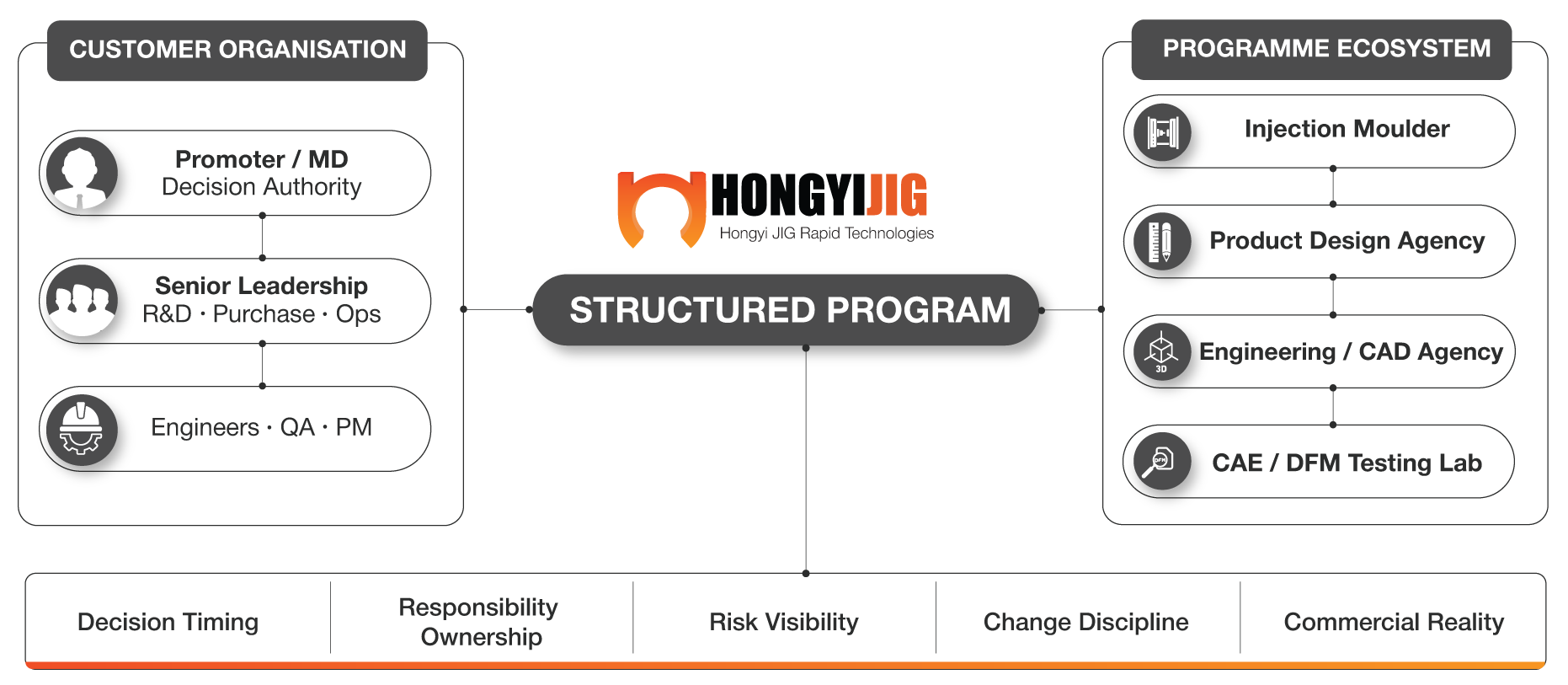
✓ Governance sits between
- Business intent
- Supplier execution
- Manufacturing reality
✗ Governance does not
- Design products
- Manufacture moulds or parts
- Push suppliers to deliver
Governance defines ownership before work begins. Not effort after problems appear.
THE CHANGE
What changes when governance is present
01
Teams stop reacting to late surprises.
When governance defines entry criteria at every stage, surprises do not surface at trials. They are caught at the decision point where correction is still affordable.
02
Suppliers escalate risks earlier.
When suppliers know that every stage has a structured review, they surface concerns before commitment, not after steel is cut and options have closed.
03
Decisions stop floating without owners.
Every decision has a defined owner, a defined moment, and a documented outcome. No verbal commitments. No informal approvals. No assumptions.
04
Execution becomes predictable.
Not because problems disappear. Because the system catches them before they become expensive. Good teams perform better when the structure removes the firefighting.
05
You can commit to your customer with confidence.
Most companies lose control of their downstream commitments because their upstream programme has no structured governance. When your programme is governed, your delivery commitments to your own customer rest on evidence, not optimism.
06
Your revenue arrives as planned.
An unstructured programme does not just delay a launch. It delays the revenue that depended on it. Governance protects the timeline that your business plan was built on.
When governance is present, good teams perform better. The system removes the firefighting. And the outcome your business depends on arrives when you planned it to.
B1
Kickoff
B2
Engineering
B3
Pre-Tooling
B4
Manufacturing
B5
Trials
B6
Shipment
B7
Installation
B3 - Point of No Return
WHERE IT ENTERS
Governance enters before execution begins.
Not after problems appear.
Every B-Series stage has defined entry criteria, decision gates, and documented evidence requirements. Nothing advances because someone feels ready.
B1
Project Kickoff and Ownership Lock
Authority defined. Scope authorised.
B2
Engineering Review and Supplier Lock
DFM evaluated. Right supplier selected. Not changed.
B3
Pre-Tooling Governance
SOR locked. BOP locked. Bid before.
B4
Tooling Manufacturing Governance
Supplier governed during manufacture. Not chosen.
B5
Trials, Validation and Buy-Off
Trials advance on evidence. Not supplier confirmation.
B6 - B7
Dispatch and Installation
Documented handover. No future blame exposure.
Nothing advances because someone feels ready. It advances when evidence confirms it.
THE TRANSFORMATION
From reacting to problems. To governing before they form.
WITHOUT GOVERNANCE
"We are reacting to problems."
WITH GOVERNANCE
"We are governing the programme before problems escalate."